
It's 2:14 AM

Your night nurse is about to call.
CareCompile already did.

2:14 AM. A patient on the third floor doesn't look right. Your charge nurse is reaching for the phone to wake the on-call hospitalist. NORA flagged the deteriorating labs at 1:47 AM. The on-call has already seen them. The orders are pending. Nothing fell through the cracks.

39 specialist agents · reads every HL7 message · any HL7-capable EMR · on-prem or cloud · no rip-and-replace
Liability protection 24/7
Catches what staff miss
Works with your EMR
HIPAA Compliant
Live: what CareCompile is catching right now 3 patients · no human clicks
1,656
Patients
44,651
Labs
60,733
Analyses
39
Agents
HIPAA Compliant
AES-256 Encrypted
TLS 1.3 in Transit
7-Year Audit Trail
HL7 v2.x Native
BAA Available
What it does

Watch one lab turn into one clinical save.

Six seconds from HL7 arrival to on-call notification. No clicks. No nurse paging.

Live case · 11:52 PM
Mrs. Garcia, 68F
MRN 482911 · 3rd Floor · Post-op Day 2
Creat
3.2 ↑
K+
6.1 ↑
BUN
52
Before CareCompile
Lab waits in queue until 7 AM rounds. Nephrology consult at 9. Dialysis at 14:00.
Inside CareCompile
6 seconds
HL7 ORU^R01 received 11:52:14
Parsed, tied to active visit — no human involvement.
N
Nephrology · AKI Stage 2 detected 11:52:15
Creatinine up 1.8 since admission. Fluid repletion + renal US.
Rx
Pharmacy · Vancomycin dose conflict 11:52:15
1g q12h exceeds safe dose at eGFR 28 → suggest 750 mg q24h.
C
Cardiology · Hyperkalemia, ECG changes likely 11:52:16
K+ 6.1 — immediate 12-lead, calcium gluconate protocol ready.
NORA · Multi-system alert synthesized 11:52:17
3 agent findings reconciled → one clinical picture, full context assembled.
Dr. Patel notified — chart already open 11:52:18
Intervention at 12:08 AM. Dialysis avoided. Stable by morning rounds.
4 sec
Lab to clinical picture
5 agents
Specialist reasoning, parallel
0 clicks
From nursing / overnight
7 hrs
Saved vs. morning rounds
Case illustration · synthetic patient data · every agent and timestamp above is shipping today.
See It In Action

The platform. Not a mock-up.

Real software. Real HL7, FHIR and clinical reasoning. Every screen below is a shipping view from the CareCompile platform.
Synthetic data only. Every patient name, MRN, diagnosis, vital and lab result shown on these screens is generated by MediFlow — CareCompile's synthetic patient-data engine for HL7/FHIR testing. No real PHI is displayed. Any resemblance to actual persons, living or deceased, is purely coincidental.

Physician AI · v2.8.1

Specialist-level AI, for every patient, every hour.

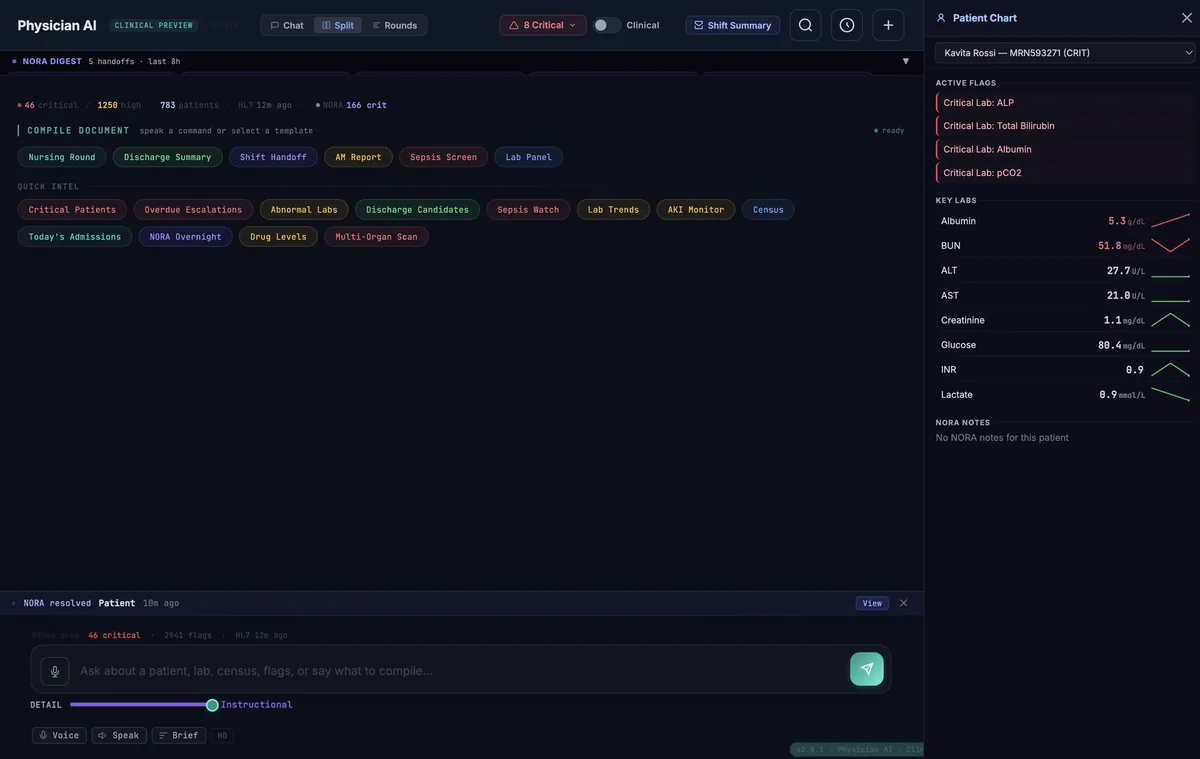
Physician AI reads the full chart, ranks what matters, and hands hospitalists the insight a subspecialist would — in under two seconds. Built for the 3am call when no specialist will answer the phone.

  • NORA Digest, Active Flags, and Quick Intel in one split view
  • 30 specialties · 136 clinical workflows · 18 query scopes
  • 92% clinical accuracy across 673 synthetic validation patients
See the accuracy methodology →
🔒carecompile.com / physician-ai
Physician AI split view with NORA Digest, Active Flags (ALP, Bilirubin, Albumin, pCO2) and Patient Chart for synthetic patient Kavita Rossi MRN593271
MediFlow v5 · Simulation Platform

Synthetic HL7 and FHIR, at clinical scale.

MediFlow generates realistic ADT, ORU, MDM and DFT messages at unit volume — patients, vitals, 15 lab panels, pathology, telemetry. It's how we train, test and stress the platform without ever touching real PHI.

  • 27 message types per patient · 15 full lab panels
  • MLLP + HTTP bridge · VistA FHIR · OpenEMR connectors
  • Every demo patient originates here — never in production
Explore MediFlow v5 →
🔒mediflow.carecompile.com / dashboard
MediFlow v5 dashboard with 142 synthetic patients, 2,026 HL7 messages, 100% AA rate and a live patient census
Patient Registry

Every flag, every MRN, one surface.

The hospitalist's opening screen: 783 synthetic patients filtered by flags, acuity and admission status, with one-tap access to Ask AI, FHIR detail or OpenEMR chart. Advanced search saves as a preset per clinician.

  • Flagged, critical, normal, active — filter on any of it
  • ADT status and lab freshness surfaced on every row
  • “Patients to Watch” and saved filters per user
🔒carecompile.com / patients
CareCompile Patient Registry with 783 synthetic patients, evening handoff view, MRN search and advanced filters
NORA · Neural On-call Reasoning Agent

The agent that orders labs while the hospital sleeps.

NORA runs a 60-second loop across every admitted patient — reasons from the chart, decides which panels to order, which need physician sign-off, and which to block. 32 auto-fire panels. 7,293 labs ordered to date.

  • Three tiers: auto-fire · approval required · blocked
  • 63-second median session · 100% success rate
  • Every decision audit-logged with confidence and deferral tags
How NORA reasons →
🔒carecompile.com / admin / nora
NORA Neural On-call Reasoning Agent dashboard showing 32 auto-fire panels including ABG, Ammonia, BMP, CBC, CMP, COAG, COVID, CRP, D-Dimer, Digoxin and Factor V Leiden
EKG AI

12-lead ECG with side-by-side AI interpretation.

Every generated ECG comes with structured analysis — rhythm, rate, axis, intervals, ST/T changes, clinical impression, immediate actions. Rendered as SVG so it prints, scales and ships to the chart without quality loss.

  • SVG 12-lead trace · calibrated · print-ready
  • Correlated with same-patient labs (ALT, ALP elevation flags)
  • Three tabs: image · interpretation · side-by-side
🔒carecompile.com / cardiology / ecg
CareCompile EKG AI Normal Sinus Rhythm analysis with 12-lead trace, rhythm, rate, axis, intervals, ST/T changes and immediate actions

Ready to see this on your unit?

We're opening access to a small cohort of hospitals and health-IT teams. First deployments run on synthetic data with MediFlow — same screens, your workflows.

About the data shown on these screens

All patient names, medical record numbers (MRNs), diagnoses, vital signs, laboratory values, ECG traces and clinical narratives shown across these screenshots are synthetic. They are generated by MediFlow, CareCompile's internal synthetic patient-data engine, which produces HL7 ADT, ORU, MDM and DFT messages for platform testing, demonstrations, clinical validation exercises and regression testing.

No Protected Health Information (PHI) is displayed on this page or used in CareCompile demos. The synthetic records are algorithmically generated and are not derived from, scraped from or copied from any real patient record, dataset, hospital system or third-party source. Any resemblance to actual persons — living or deceased — is entirely coincidental.

This approach is intentional: CareCompile's clinical validation and product development workflows never require or display real PHI. Real-world deployments operate under the customer's BAA and existing EMR security boundary.

The Problem

The patient who codes at 3 AM
is the one nobody saw coming.

Every rural CEO has lived this. A nurse runs the night floor for 28 patients. The hospitalist is asleep at home. The labs come back at 1:53 AM with a creatinine of 3.2 and a lactate of 4.8 — and they sit in the queue until morning rounds. By then it's a transfer, a lawsuit, or a death certificate. You can't hire your way out of this. You can't budget your way into a modern EMR overnight. CareCompile makes sure those labs never sit alone again.

U.S. Dept. of Health & Human Services | Health Professional Shortage Areas
70%
Shortage Areas Are Rural
7 in 10 federally designated health professional shortage areas are in rural communities. Specialists are even scarcer — only 9% of physicians practice where 20% of Americans live. (HHS)
College of American Pathologists Q-Probes (121 institutions) & AAMC
5+ hrs
Critical Results Waiting
Up to half of critical lab results wait 5+ hours before a caregiver takes action. In sepsis, each hour of treatment delay increases mortality risk by 4–9%. (CAP Q-Probes / AAMC)
Kaufman Hall Physician Flash Report, Q2 2025
$700K+
Per Specialist, Per Year
A single intensivist costs a hospital $700K+ annually in salary, benefits, and overhead. 24/7 coverage requires multiple FTEs — a cost most small hospitals simply cannot absorb. (Kaufman Hall)
Chartis Center for Rural Health, 2025 State of Rural Health Report
432
Rural Hospitals Vulnerable to Closure
Nearly 1 in 5 rural hospitals are at risk of closing. In 16 states, the median rural hospital operates at a loss. Communities are losing access to care they can't replace. (Chartis, 2025)
Navigant Rural Hospital CEO Survey
69%
Recruitment Is the #1 Challenge
Nearly 7 in 10 rural hospital CEOs identify physician recruitment as their top operational challenge. Only 9% of U.S. physicians practice in rural areas — and specialists are even harder to attract. (Navigant)
Health Affairs, Johnston et al. — Rural-Urban Specialist Access Study
55%
Specialist Gap Drives Preventable Hospitalizations
Access to specialists is the single biggest factor explaining why rural patients are hospitalized for conditions that could have been prevented — accounting for 55% of the rural-urban gap. (Health Affairs)

CareCompile doesn't replace anything. It makes sure nothing gets missed.

It sits quietly on top of the EMR you already have — Epic, Cerner, Meditech, McKesson, HMS, or any HL7-capable system. When patient data arrives, it's read, analyzed, and surfaced to the right clinician in seconds. No rip-and-replace. No new workflows for your staff. No extra clicks.

Who It's For

Built for hospitals of every size.

Same system, different scale. Whether you run a 25-bed critical access hospital, a 300-bed regional, or an 800-bed academic center, CareCompile connects to your existing EMR and watches every patient — on every shift, in every unit.

Critical Access to Academic Centers

From 25-bed rural hospitals where the nearest intensivist is two hours away, to 800-bed tertiary centers running 24/7 specialist rotations. Same deployment. Same coverage. Configured to the scale and specialty mix of your facility.

Night Shifts & Weekend Coverage

The hours where coverage is thinnest are the hours where things fall through. CareCompile works hardest when your team is smallest — watching every critical lab, every vital, and every medication order until the day shift walks in.

Any HL7-Capable EMR.

No rip-and-replace. No proprietary integration. CareCompile connects via HL7 v2.x — the universal standard supported by Epic, Cerner, Meditech, and virtually every modern clinical system. If it speaks HL7, we connect.

International Health Systems

Expanding to health systems in Latin America, Africa, and Southeast Asia where specialist access is the exception, not the norm. HL7 v2.x is spoken worldwide — and CareCompile is built to travel.

Pilot Partner Program — now open

We're picking 10 hospitals
to catch their first AI save with us.

Real deployment. Real HL7 feed. Real clinical team. We cover the build, you define the success criteria. If it doesn't catch what we said it would — you walk, no commitment, no invoice.

What we provide
  • Full CareCompile deployment (on-prem or cloud)
  • HL7 integration + 2 weeks MediFlow synthetic validation
  • Specialist agent configuration for your facility
  • Named engineering + clinical support
  • Weekly review cadence with your team
Who we want
  • Any size — 25 beds to 800 beds
  • Night or weekend specialist coverage gaps
  • HL7-capable EMR (any vendor)
  • A physician champion willing to review
  • Appetite to be first. Credit when it lands.
Pilot terms
  • 60–90 days. Clearly scoped exit.
  • Heavily subsidized — a fraction of list price
  • No multi-year lock-in at pilot
  • Success = your criteria, measured jointly
  • Walk at 30/60/90 with written findings
The 5 numbers we measure together
Pilot success isn't a feeling. It's a spreadsheet.
T-to-R
Time to clinical recognition — before vs. with CareCompile
Catches
Critical findings surfaced before morning rounds
Noise
Alert fatigue score — must trend down, not up
Saves
Clinical events where earlier recognition changed the outcome
NPS
Nurse and physician satisfaction with the workflow
Apply to be a pilot partner
Slots remaining · 7 of 10 · reviewed weekly
Works with any HL7-capable system

If it sends HL7 v2.x, CareCompile connects. No proprietary API. No custom development.

How it works

Parallel AI agents. One unified clinical narrative.

CareCompile processes every patient query through coordinated specialist agents — fusing data across every clinical system you run — to deliver a clinical output no single model can produce alone.

HL7 Stream
Data In
27 HL7 message types · ADT · ORU · MDM · Real-time
Agent 1
Coordinator
Routes query · Assigns agents · Queries all data layers
Parallel Agents
Agent 2
Diagnostics
Differential · Lab patterns · Critical values
Agent 3
Pharmacology
Drug interactions · Contraindications
Agent 4
Risk
Discharge · Sepsis · Safety flags
3 of 39 agents shown · Tiers 1–5 cover cardiology through revenue cycle · Configured per facility
Agent 5
Compiler
Synthesizes all outputs into a structured clinical narrative
Output
Clinical Narrative
Diagnosis · Drugs · Risk · Discharge · Streamed live
Each agent queries simultaneously:
HL7 Database EHR FHIR R4 Legacy EHR Bridge
Real-time fusion at inference — no data silos
FHIR Fusion · Data Layers
We don't just read your EMR. We fuse across every system.

Hospitals run 10+ clinical systems. CareCompile connects across all of them simultaneously at inference time.

Layer 1 · Primary
CareCompile Database
Real-time HL7 ingestion · 27 message types
Vitals · Labs · Notes · Admits · Orders · AI flags
Layer 2 · Longitudinal
EHR FHIR R4 Endpoints
Full visit history + vital trends across encounters
Encounters · Trends · Conditions · Documents
Layer 3 · Connected Systems
Specialty & Legacy Bridges
PACS · cardiology · lab · pharmacy · dictation
FHIR R4 bridge translation across legacy systems
Any systems you run One unified clinical picture
Tier 1 — Critical Immediate life-threat recognition
Sepsis ScreeningCardiac Arrest RiskPulmonary EmbolismHemorrhagic ShockDKA DetectionStroke AlertARDS CriteriaCritical Value Escalation
Tier 2 — Specialist Organ-system expert analysis
CardiologyNephrologyPulmonologyNeurologyInfectious DiseaseGastroenterologyEndocrinologyHematologyOncology
Tier 3 — Pharmacology Drug safety and interaction intelligence
Drug–Drug InteractionsRenal Dose AdjustmentAntibiotic StewardshipContraindication CheckVancomycin MonitoringNarrow Therapeutic IndexAllergy Cross-Reactivity
Tier 4 — Clinical Operations Workflow, discharge, and documentation
Readmission RiskDischarge CriteriaNursing DocumentationOperative Note AnalysisRadiology IntegrationAuto-Discharge SummaryBed Board IntelligenceOutcome Tracking
Tier 5 — Revenue & Compliance Billing, coding, and regulatory
ICD-10 SuggestionDRG OptimizationCharge Capture AuditPrior Auth SupportDenial Risk FlagCompliance CheckClinical Documentation Improvement
92–100%
Accuracy · validated
The AI wasn't hallucinating. It was right.

In our first structured internal validation (synthetic data · 13 clinical claims · February 2026), apparent "hallucinations" at 54% accuracy resolved to 92–100% when all FHIR sources were verified simultaneously. The AI was pulling from EHR systems the auditor hadn't checked. Physician validation is actively expanding.

See the methodology
CareCompile Internal Validation · February 2026 · Synthetic data · Physician validation in progress
Autonomous Overnight Monitoring

The AI that watches every patient
while your team sleeps.

Most clinical alerts surface when a physician happens to check the chart. NORA — the Neural On-call Reasoning Agent — runs continuously in the background, proactively reviewing every active patient against new HL7 data so nothing critical slips through an overnight gap.

By the numbers
60s
Patient review cycle — every active admission, non-stop
100%
Patients covered — not sampled, every active bed
0
Clicks required — NORA runs without being asked
4
Severity tiers — critical, high, medium, informational
24/7
Active nights, weekends, holidays — no gaps
<2s
From new HL7 data to NORA flag generation
Clinical coverage
Critical Lab Values
Flags panic values the moment the ORU message arrives — before the chart is opened
Vital Deterioration
Tracks trending vitals — BP drops, rising HR, falling SpO2 — across consecutive readings
Radiology Findings
Reads incoming MDM reports for urgent findings — PE, pneumothorax, intracranial hemorrhage
Sepsis Criteria
Evaluates SOFA components — lactate, WBC, HR, MAP — across every active ICU and step-down patient
Medication Conflicts
Cross-checks new orders against active medications for nephrotoxic overlaps and contraindications
Overnight Gaps
Detects patients with new data that has not been reviewed by any clinical user in the past 4 hours
What physicians receive
OUTPUT 01
Morning Handoff Report
Every overnight NORA finding — resolved and open — compiled into a structured handoff before rounds
OUTPUT 02
Critical Patient Dashboard
Live view of every patient with an unacknowledged critical or high-severity NORA flag
OUTPUT 03
Physician AI Context
NORA findings are injected directly into Physician AI — so the first query of the day already knows what happened overnight
OUTPUT 04
Timestamped Flag Timeline
Every flag carries an exact timestamp, the HL7 message that triggered it, and the clinical reasoning behind the severity tier
OUTPUT 05
Severity-Tiered Queue
Critical flags surface first. Resolved flags are archived. Physicians review in priority order, not arrival order
OUTPUT 06
Acknowledgment Audit Trail
Every flag acknowledged is logged with timestamp and physician ID — full audit trail for clinical governance and risk review

NORA operates as a separate autonomous agent — independent of the physician-facing interface. Findings feed directly into the morning handoff report, the Physician AI context, and the critical patient dashboard. Every flag is timestamped, tiered by severity, and awaiting physician acknowledgment.

Enterprise-ready

Live in under 24 hours. Compliant from day one.

No rip-and-replace. No months-long integration. CareCompile connects to your existing HL7 stream and is analyzing patients the same day — under a BAA, encrypted end-to-end, with a 7-year audit trail.

01

Point Your HL7 Endpoint

One setting change — no code, no middleware. Your EMR, lab, or interface engine forwards HL7 to CareCompile.

~1 hour
02

Indexing & Validation

Messages parse, map to patients, and run through MediFlow synthetic validation against your facility's patient mix.

Same day
03

Live · All Shifts

39 specialist AI skills active. Every lab, vital, and note analyzed the moment it arrives — nights, weekends, holidays.

< 24 hrs total
Security & compliance
Healthcare-grade from the ground up.
HIPAA-aligned
Privacy & Security Rules
AES-256
Encrypted at rest
TLS 1.3
In transit
7-yr audit
Immutable logs
BAA
Executed pre-PHI
On-prem
Air-gapped option

No proprietary connectors. No dedicated integration team. No vendor lock-in.
The HL7 standard is the integration.

Honest answers

The questions you'd ask on the call.

If you're running a hospital, these are the five things going through your head. Here are the real answers — before you pick up the phone.

CareCompile is clinical decision support, not an autonomous prescriber. Every agent finding is advisory. Every critical alert routes to a licensed physician who makes the final call before anything reaches the patient. NORA can queue medication holds and starts, but they sit as pending-approval chart notes until a physician signs off — the system can't push an order to the pharmacy on its own. Your physicians retain full clinical authority. The legal standard of care remains exactly where it is today: with the attending.

On accuracy: In our first structured internal validation (synthetic data, 13 discrete clinical claims, February 2026), apparent "hallucinations" at 54% accuracy resolved to 92–100% when all FHIR sources were verified simultaneously. The AI wasn't making things up — it was pulling from EHR systems the auditor hadn't checked. Physician validation is actively expanding.
CareCompile is designed to be quiet by default. It does not page anyone about routine labs. NORA only escalates when a patient crosses a critical threshold — the kind of finding a specialist would want to know at 2 AM regardless. And when it does notify, the on-call clinician receives a pre-synthesized clinical picture, not a single data point. No more "let me pull up the chart" phone calls. Our pilot design assumes fewer pages, better context, faster decisions — not more noise.
A single 24/7 intensivist runs $700K+ per year fully loaded. A nighthawk radiology service runs $250K–$600K depending on volume. CareCompile is engineered to come in at a fraction of that — typically less than 10% of a single specialist FTE for a critical-access deployment, with tiered enterprise pricing above that. Exact numbers depend on bed count, message volume, and whether you choose cloud or on-prem. During early access, we're working with pilot partners on flexible terms. A 30-minute call gets you a real number.
Weeks, not years. Because CareCompile reads the HL7 stream your EMR already produces, there's no rip-and-replace, no custom interface build, and no workflow redesign for your clinical staff. A typical pilot deployment: 1 week to configure your HL7 forwarding rule, 1–2 weeks running synthetic traffic through MediFlow v5 to validate every agent against your facility's patient mix, then go-live with a defined scope. We've done Meaningful Use conversions in 14-hour phone calls — this is dramatically less invasive than that.
No. CareCompile sits on top of your existing EMR — Epic, Cerner, Meditech, McKesson, HMS, or any HL7-capable system. Your nurses chart the way they chart today. Your physicians use the EMR the way they use it today. CareCompile reads the messages your EMR is already sending and returns intelligence through its own interface (or pushes alerts to your existing paging system). Nothing about your clinical workflow changes.
CareCompile is HIPAA-aligned, AES-256 encrypted at rest, TLS 1.3 in transit, and maintains a 7-year audit trail. A Business Associate Agreement (BAA) is executed before any PHI touches the system. For health systems with strict data residency requirements, CareCompile deploys fully on-premises and air-gapped — no internet required, no PHI ever leaves your network, and AI inference runs on your own hardware. Cloud and hybrid deployments are also available.
CareCompile is in pre-commercial development and is conducting the SaMD (Software as a Medical Device) classification assessment required under current FDA guidance. Today it operates as clinical decision support that augments physician judgment — not as a standalone diagnostic device. All output is advisory and requires licensed clinician review before any clinical action.
CareCompile speaks HL7 v2.x — the universal clinical messaging standard. If your EMR, lab system, or interface engine (Mirth, Cloverleaf, Rhapsody) can send HL7, it already speaks CareCompile's language. Configure your system to forward HL7 messages to our secure endpoint and you're connected. For deeper clinical reasoning, CareCompile also queries FHIR R4 endpoints across connected systems. No proprietary API. No custom development. No new interface engine to license.
Yes. Every CareCompile engagement starts with a scoped pilot — defined success criteria, defined duration, defined exit. We'd rather you see it catch something real in your hospital than sign based on a pitch deck. Pilots typically run 60–90 days with a joint review at the midpoint and clear metrics on time-to-clinical-recognition, alert fatigue, and clinician satisfaction.
Your Options

The math is not close.

There are three ways to handle specialist coverage. Only one doesn't require hiring, waiting, or leaving patients unmonitored overnight.

Capability CareCompile Specialist Contract No Coverage
Annual cost Contact for pricingVolume-based, no FTE cost $700K+ per FTESalary, benefits, overhead $0 upfrontAdverse outcome liability
24/7 availability Always onNights, weekends, holidays On-call onlyResponse time varies No coverageHospitalist on their own
Specialties covered 39 skills, 30 specialtiesConfigured per facility 1 per hireEach specialty costs separately 0Transfer or manage blind
Setup time < 24 hoursHL7 config, no code 3–6 months recruitingCredentialing adds time ImmediateNothing to set up
EMR integration Any HL7-capable EMRNo custom API needed Manual chart reviewNo automatic data flow N/A
Analysis latency < 1 secondFrom HL7 receipt to result Minutes to hoursDepends on on-call response Never
Rural hospital fit Built for itWorks with legacy systems Hard to recruitSpecialists avoid rural areas Possible todayUnsustainable long-term

Clinical Decision Support Notice: CareCompile is a non-diagnostic clinical decision support tool intended to augment — not replace — physician judgment. All AI-generated analyses are advisory only. Clinical decisions remain the sole responsibility of the licensed treating physician or clinician. CareCompile is not FDA-cleared or FDA-approved as a medical device. It is not intended to diagnose, treat, cure, or prevent any disease or medical condition. For investigational and decision support use only. Validation with practicing physicians is ongoing.

Early Access

Request Early Access

We're building the engine and refining the algorithms. If you're a health system, integration analyst, or EHR vendor interested in early partnership, let's talk.

Fields marked with * are required

Prefer to skip the form?

Book a 30-Minute Demo on Calendly
Built by Mario Casamalhuapa — 15+ years in hospital EMR integration. Cerner · Epic · McKesson · Meditech · HMS. Mirth & Cloverleaf conversions, Meaningful Use, procurement. Critical access hospitals to tertiary academic centers.